


1948: Israel's First Fighter Aircraft

Updated: Sep 10

Part 1: Ad Halom Bridge. Attacking the Egyptian army
On the afternoon of 29 May 1948, just two weeks after Israel’s declaration of independence, the fledgling state faced an existential threat. An Egyptian armoured column — hundreds of vehicles, infantry, artillery, and armour — had pushed north along the coastal road and reached the outskirts of Isdud (today’s Ashdod). Only about 30–35 kilometres separated them from Tel Aviv. If the Egyptians crossed the bombed-out Mamluke bridge over the Lakhish River and continued, they could split the country, link with Jordanian forces, and potentially end the Jewish state before it had truly begun.
Into this desperate moment flew four Avia S-199 fighters — the only fighter aircraft the Israeli Air Force possessed. They were Czech-built copies of the WW2 Nazi German Luftwaffe Messerschmitt Bf 109G, powered by a mismatched Junkers Jumo 211 bomber engine and carrying a host of dangerous flaws. The planes were unreliable, difficult to fly, poorly armed for their era, and more dangerous to their own pilots than to a well-equipped enemy in many respects.
Yet on that day, and in the days that followed, these “Messers” (or “Sakeen” — knife — in Hebrew slang) did something extraordinary. They helped stop the Egyptian advance at what became known as Ad Halom — “Until Here” — and, a few days later, ended the Egyptian bombing of Tel Aviv itself.
This is the story of those first IAF fighter sorties, the men who flew them, the impossible odds they faced, and why a handful of substandard aircraft proved “good enough” to help save the State. It is also a story I love sharing with visitors on tours of Israel’s 1948 battlefields — standing at the Ad Halom Bridge memorial near Ashdod, looking out over the very ground where history pivoted.
The Desperate Scramble for Arms
When Israel declared independence on 14 May 1948, it had no air force worthy of the name. The predecessor Sherut Avir (“Air Service”) operated a motley collection of light civilian aircraft — Piper Cubs, Austers, a few Bonanzas and Rapides — useful for reconnaissance, supply drops to isolated settlements, and occasional harassment with hand grenades, soda bottles or small bombs. There were no fighters, no bombers of consequence, and almost no trained combat pilots or infrastructure.
The Arab states that invaded immediately after independence — Egypt, Syria, Iraq, Lebanon, and Transjordan — brought British- and French-supplied aircraft, including Spitfires, and enjoyed air superiority. Egypt in particular used converted C-47 Dakotas (DC-3s) as bombers and had Spitfires for escort and ground attack. Tel Aviv and other cities came under air attack almost immediately.
Israel faced a crushing arms embargo. The United States, Britain, and much of the international community refused to sell weapons to the new state while Arab armies received supplies through existing treaties and channels. The Jewish Agency and Haganah had been smuggling arms for years, but the need was now acute and immediate.
The most critical lifeline came from an unlikely source: Czechoslovakia. In the chaotic post-war period, the Czechs still had factories, surplus parts from Nazi German Luftwaffe production, and a willingness (for a time, before Stalin tightened control) to sell to anyone with hard currency. Israel purchased 25 Avia S-199 fighters — the only modern combat aircraft it could obtain quickly. The first four arrived in crates in mid-May 1948, flown in disassembled form aboard C-46 Commando transports. One such flight crashed in fog near Tel Nof, destroying a precious airframe and killing a crew member. The surviving aircraft were rushed to assembly at makeshift bases (including Ekron/Tel Nof area). Mechanics and pilots worked around the clock with minimal manuals, testing, or proper facilities.
Pilots were a mix of local sabras and Mahal volunteers — World War II veterans from the United States, South Africa, Britain, Canada, and elsewhere who came to fight for the Jewish state. Many had flown Spitfires, Mustangs, or bombers over Europe. They now had to master a very different, flawed machine in days rather than weeks. Radios were often missing or non-functional. Maps of the new country were rudimentary. Everything was improvised.
This was the context in which four Avia S-199s — barely airworthy, barely tested — were ordered into combat on 29 May.
The Avia S-199: A Dangerous, Unreliable “Gift”
The Avia S-199 was never a great fighter. It was a post-war Czechoslovak adaptation of the Messershmitt Bf 109G airframe using available components. With the original Daimler-Benz DB 605 engine unavailable in quantity, Czech designers substituted the Junkers Jumo 211F — a bomber engine from the infamous Heinkel He 111 — paired with a large, paddle-bladed propeller.

The results were problematic:
Handling and torque: The combination created massive torque and swing on takeoff and landing. The Bf 109’s already narrow-track undercarriage made the aircraft twitchy and prone to ground loops or crashes. Many pilots feared takeoff and landing more than enemy fire.
Gun synchronization: The machine guns mounted in front of the cockpit were not properly synchronized for the new propeller. Early test-firings on the ground revealed the terrifying possibility of shooting off one’s own propeller in flight. In combat, pilots sometimes restricted themselves to the wing mounted 20 mm cannons when possible.
Even the cannons would often jam.
Performance: Top speed and climb rate were inferior to the Spitfires flown by Egypt. The aircraft was heavy, underpowered for a fighter, and had limited range.
Maintenance: Hydraulic systems, fuel systems, and electrics were troublesome. At any given time, only a handful of the squadron’s aircraft were serviceable.
Czech pilots had nicknamed it the “Mule”. Israelis called it the “Sakeen” (knife) or simply “Messer.” It was, in the words of those who flew it, dangerous and unreliable — “more dangerous to us than to the enemy” in many situations.
Yet it was what Israel had. And in the hands of determined pilots, flying at the very edge of their own survival, it achieved something the specifications could never predict: it put fear into the hearts of a far larger and better-equipped enemy.
29 May 1948: Operation Pleshet and the First IAF Fighter Sortie
By late May the Egyptian 2nd Brigade (elements of the 2nd and 9th Battalions) had advanced to Isdud. Their column — estimated by Israelis at up to 500 vehicles and thousands of troops with armour and artillery — halted briefly at the bombed-out Jisr Isdud bridge (later Ad Halom) while engineers prepared a Bailey bridge. From there the road to Tel Aviv lay open.
Israeli intelligence and observation posts (including at nearby Nitzanim) watched in alarm. Givati Brigade and other units were desperately thin on the ground. The famous line attributed to the period captures the stakes: between the Egyptian army and Tel Aviv stood only a few hundred Israeli soldiers.
At 19:45 on 29 May, four Avia S-199s took off from the Ekron area led by Lou Lenart, an experienced American volunteer pilot. With him were Modi Alon, Ezer Weizman (later IAF commander and President of Israel), and Eddie Cohen, a South African volunteer. Each aircraft carried two 70 kg bombs (dropped manually after pulling safety pins) plus cannons and machine guns. The planes had received almost no proper test flights. Radios were unreliable or absent. Lenart, new to the country, did not initially know the exact location of Ashdod — he simply flew south until the massive Egyptian column came into view.
The mission was part of Operation Pleshet, the Israeli counter-effort to disrupt and halt the Egyptian northward push. The air attack was the first combat sortie of the newly formed 101 Squadron — Israel’s first fighter unit.
The four aircraft made multiple strafing and bombing runs over the Egyptian positions around Isdud and the bridge area, despite intense 37 mm anti-aircraft fire. Damage to vehicles and troops was limited — the bombs were small and accuracy was constrained by the aircraft’s handling and the pilots’ inexperience with the type. But the psychological effect was immense.
Egyptian radio intercepts revealed the shock: “We have been heavily attacked by enemy aircraft, we are dispersing.” Egyptian commanders had believed Israel possessed at most a couple of Spitfires or nothing at all. The sudden appearance of fighter aircraft — even flawed ones — changed their calculus. The column did not push forward across the bridge. Egyptian strategy in the sector shifted from offensive to defensive.
The cost was high. Eddie Cohen’s aircraft was hit by ground fire. His burning plane crashed; he was killed — one of the first IAF combat fatalities. Modi Alon’s aircraft ground-looped on landing and was written off. Other planes were damaged. Roughly 25% of the pilots and 50% of the aircraft were lost or heavily damaged in this single mission. But the objective had been achieved.
Ground elements of Operation Pleshet (Givati Brigade units, Negev Brigade companies, and others) launched supporting attacks and harassment over the following days. Some ground assaults were costly and only partially successful, but the combined effect — air shock plus ground pressure — ensured the Egyptians never resumed their northward advance. The bridge became Gesher Ad Halom — “Until Here.” It remains one of the most symbolically powerful sites of the 1948 war.
When I stand with visitors at the Ad Halom memorial today, pointing out the river crossing, the old bridge abutments, and the open ground where the column halted, the story feels immediate. You can almost hear the roar of those four straining Jumo engines and see the Egyptian troops looking up in disbelief.

Part 2: The First IAF Air-to-Air Victory — Modi Alon’s Double Kill, 3 June 1948
The Egyptian air force continued to bomb Tel Aviv with converted DC-3s escorted by Spitfires. These raids caused fear and casualties in the civilian population and reminded everyone how vulnerable the city remained.
On the evening of 3 June, Modi Alon was on twilight patrol over Tel Aviv in one of the remaining S-199s. He spotted a formation of four Egyptian aircraft approaching: two Spitfires escorting two DC-3 bombers. Alon swung out to sea to use the sun for cover, then attacked.
The Spitfire escort broke away. Alon made two firing passes on the bombers. Both aircraft were hit. One crashed, smoking into the sand dunes south of Bat Yam; the second went down near the coast south of Tel Nof airfield (or the Rehovot area according to some accounts). The citizens of Tel Aviv watched in astonishment and relief as the enemy bombers fell.
This was the Israeli Air Force’s first confirmed air-to-air victory — in fact, two victories in a single mission. Egyptian bombers never again attempted to raid Tel Aviv. While Egyptian Spitfires continued occasional harassment, the bomber threat to the nation’s largest city and provisional capital was effectively ended.
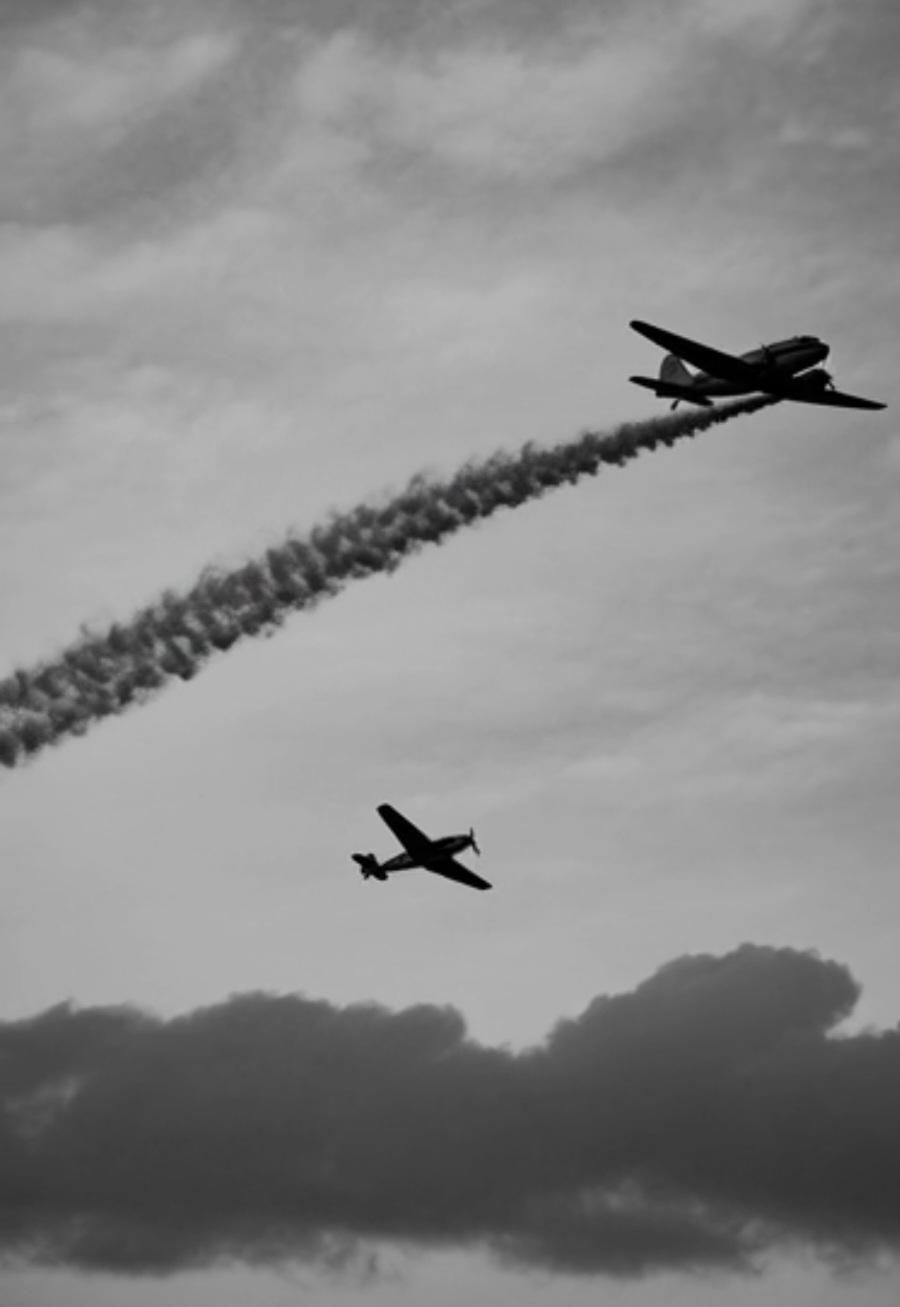
Alon’s action demonstrated that even with inferior equipment, Israeli pilots could achieve air superiority through skill, aggression, and tactical surprise. It also gave the population a powerful psychological boost at a critical moment.
Not the Best Aircraft — But Good Enough to Make a Difference
The Avia S-199 was never going to win a war on its own. It was outclassed by the Spitfires it sometimes faced (it actually shot down Egyptian Spitfires but that is another story).
Its mechanical gremlins claimed more Israeli aircraft and pilots than enemy guns in the early weeks. Only a small number were ever truly operational at once. By late 1948 most had been withdrawn or supplemented by better aircraft (including Spitfires acquired later from Czechoslovakia and other sources).
Yet in those first critical weeks of June 1948, when Israel’s survival hung by a thread, these four flawed fighters — and the heroes who flew them — miraculously delivered exactly what was needed: a psychological shock that halted an advancing enemy and a visible demonstration that Israel now had an air force capable of defending its skies.
This is the tradition our courageous IAF aircrews follow today.

Am Yisroel Chai
Yoni
(C) All Rights Reserved 2026


Comments